AI Implementation
Most AI initiatives stall between strategy and working systems. The gap is not a lack of vision — it is the integration architecture, data pipeline quality, model evaluation discipline, and team capability that determine whether an AI strategy produces deployed systems or remains a slide deck.

From RAG architecture to production deployment
At the FNDRS PE platform, the engagement covered the full stack of AI implementation: retrieval-augmented generation (RAG) architecture built over a corpus of PE-specific legal and financial documents, enabling document intelligence across deal flow, portfolio company data, and regulatory filings. This required building the data ingestion pipeline, selecting and evaluating embedding models against domain-specific document types, designing the retrieval architecture, and connecting AI outputs to the analyst workflows that consumed them.
The pattern that determines whether RAG systems work in practice is almost always data quality and retrieval precision rather than model selection. Getting documents chunked, embedded, and indexed correctly for the actual queries users run is harder than choosing a foundation model and is what determines whether the system is useful or not.
At PRAM, the engagement covered AI-assisted features within a pharmaceutical mobile product — connecting mobile application architecture to backend intelligence that supported clinical workflow automation. Healthcare AI implementation requires the same technical rigor as financial AI, with an added compliance layer governing every data handling decision.
Six dimensions of moving from AI strategy to working systems

Build vs. Buy Analysis
Evaluating which AI capabilities to build internally, which to buy from vendors, and which to build on top of foundation models — with attention to cost at scale, control, lock-in risk, and the capabilities your specific domain requires.

Model & Vendor Evaluation
Independent evaluation of AI models, platforms, and vendors against your specific use case requirements — including accuracy on domain-specific data, latency characteristics, cost at volume, and compliance fit.

Integration Architecture
Designing the system architecture that connects AI outputs to the workflows and applications that consume them — including the API design, latency requirements, and fallback behavior that production systems require.

Data Pipeline & Quality
The data infrastructure that AI systems depend on: ingestion pipelines, data quality controls, embedding and indexing architecture for retrieval systems, and the ongoing data management that keeps model outputs accurate.

Team Buildout & AI Enablement
Role definitions for AI engineering and data science functions, hiring guidance, and the enablement work that helps existing engineering teams adopt AI tooling and practices without rebuilding from scratch.

Measurement & Iteration Framework
Defining the metrics that determine whether an AI system is working: accuracy benchmarks, latency targets, user adoption measures, and the feedback loops that drive ongoing improvement after initial deployment.
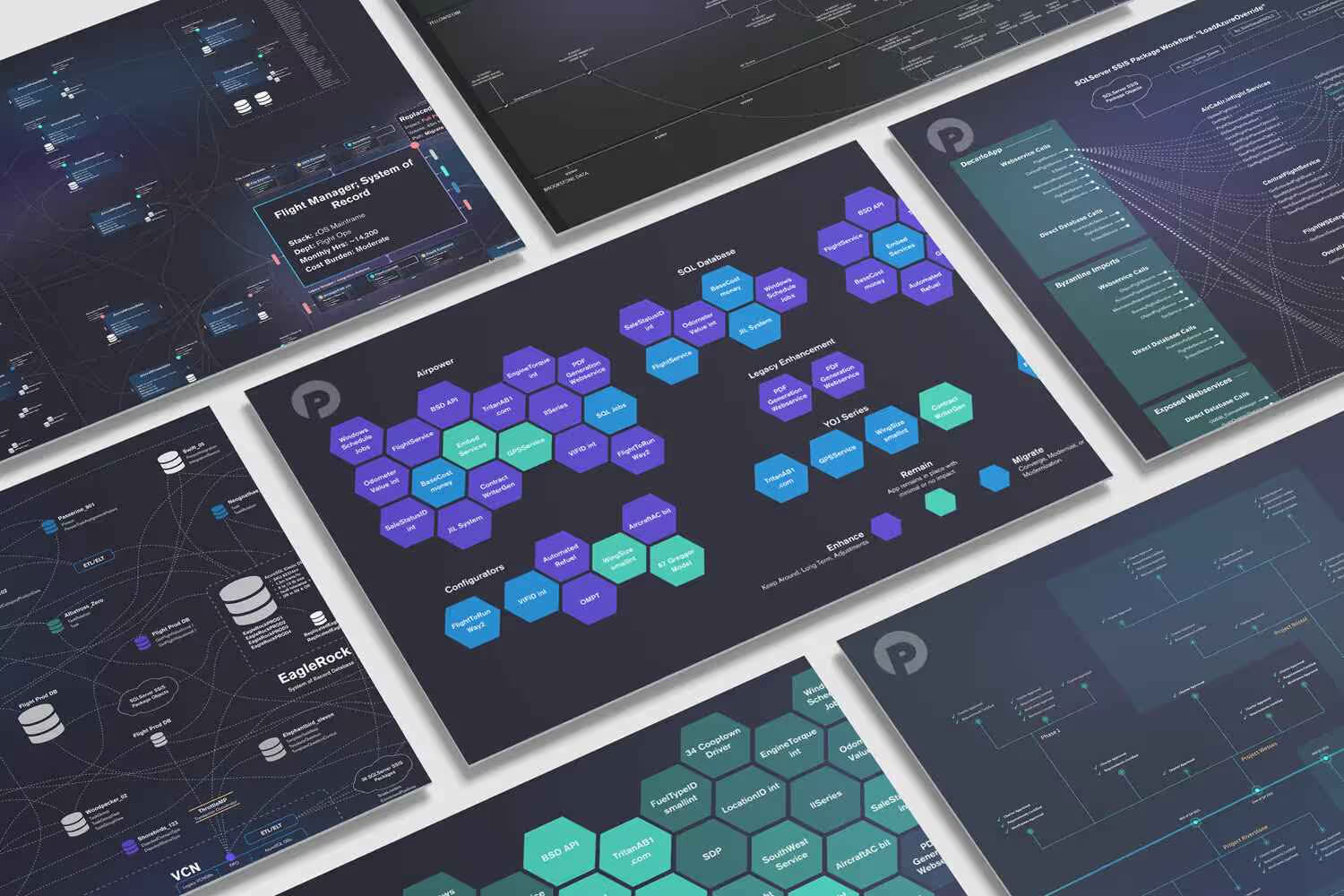
"Shawn's architecture analysis artifacts are unlike anything I've encountered - wall-sized, intricate, precise. They become the roadmap that makes modernization possible."


What the path from AI strategy to production deployment looks like
AI implementation engagements vary significantly based on starting point. Some companies have a clear use case and need the technical architecture and team to execute it. Others have AI systems in progress that are not performing as expected and need diagnosis and correction. Others need to evaluate whether a proposed AI initiative is technically feasible and commercially justified before committing significant resources.
- Use case definition and feasibility — Defining the specific AI application in terms of the data available, the accuracy required, the latency acceptable, and the integration points it must connect to — before any model selection or infrastructure investment.
- Data assessment and pipeline design — Evaluating the data the AI system will depend on for quality, completeness, and accessibility — and designing the pipeline that makes it usable for training, fine-tuning, or retrieval.
- Model evaluation and selection — Testing candidate models and vendors against domain-specific benchmarks — not general benchmarks — with the evaluation criteria weighted to what actually matters for the use case.
- Integration architecture and deployment — Designing and building the system that puts AI outputs into the hands of users or downstream systems — with the reliability, latency, and monitoring characteristics that production systems require.
- Measurement and iteration — Establishing the metrics and feedback loops that drive ongoing improvement after initial deployment — because AI systems that are not monitored and iterated degrade over time.
The difference between an AI strategy and an AI system is the implementation work. That work is technical, detailed, and requires both AI expertise and the domain knowledge to evaluate outputs correctly. Start the conversation.
AI implementation from strategy to deployed systems
Fractional CAIO with direct experience building and deploying AI systems: RAG architecture for financial document intelligence, AI-assisted healthcare mobile products, and practical AI applications across regulated industries.