A class-action settlement administration company I worked with had a returns processing problem. Hundreds of thousands of mail returns — undeliverable checks, returned notices, address changes — were being handled manually through a process that was slow, expensive, and prone to errors that compounded downstream. The ask was to automate it. The instinct of most teams in that situation is to start building: pick a tool, connect it to the existing process, iterate until it works.
That instinct is the reason most AI automation pilots fail to scale.
ishikawa
  Why AI automation underdelivers in production
    Architecture
      Process not mapped before build
      Retrofitted onto existing workflow
    Data
      Poor quality inputs
      No exception handling design
    People
      No single owner post-deployment
      Low adoption of automated output
    Governance
      No monitoring after launch
      No human escalation path for failures
The Instinct to Start Building Is Usually Wrong
When a process is painful enough, the pressure to automate it quickly is real. A manual returns processing workflow that consumes significant staff hours is obviously a target. The temptation is to connect an AI tool to the front of the existing process and see what happens.
What happens is that the AI tool performs well on the cases it was designed for and fails on everything else. The existing process, designed around human judgment at every exception, transfers all of that exception-handling responsibility to a system that was never designed to carry it. In a pilot environment, a human catches the failures. In production, at scale, the failures accumulate.
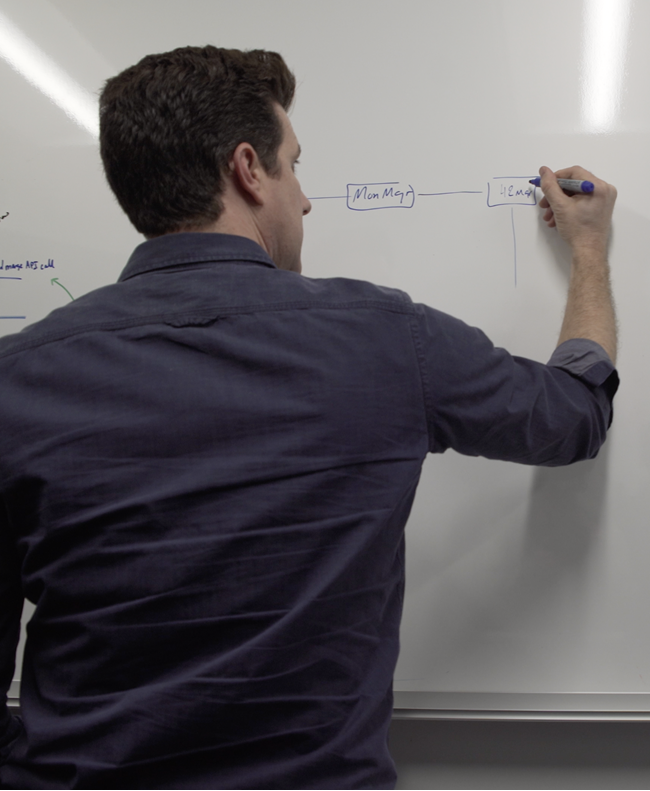
The returns processing engagement at the settlement administration company worked differently. The approach began with a comprehensive workflow map — every step, every input source, every decision point, every downstream integration, every exception type. That map became the specification. The automation was designed against it, not around the existing process structure.
The outcome was a returns processing system rebuilt from scratch with near 100% accuracy — processing the equivalent of what had previously required a substantial manual operation. The result came from the architectural decision made at the start, not from the quality of the automation tools used.
What Architecture-First Automation Requires
Building an architecture before writing code sounds obvious when stated plainly. In practice, the pressure of delivery timelines and the availability of capable tools creates a strong pull toward building before designing.
Architecture-first automation means specifying three things before any implementation begins.
The process boundary. What precisely is being automated? The returns processing engagement had a clear scope: intake of USPS mail return files, parsing against beneficiary records, routing to the appropriate resolution action, logging every decision for audit. Every step that was not in scope was explicitly out of scope — not as an oversight, but as a decision. Automation that starts with a well-defined boundary is far easier to validate and maintain than automation whose scope creeps during implementation.
The exception map. Every automated workflow encounters inputs that do not match expected patterns, upstream failures, and edge cases that the process designers did not anticipate. Architecture-first automation maps the known exceptions before building and designs explicit handling for each. Unknown exceptions — the ones that surface in production — are handled by a designed escalation path: surface the exception to a human, log the case, ensure the system continues processing others. This is different from hoping the model handles it gracefully.
The integration picture. Automated workflows do not exist in isolation. They receive input from somewhere and send output somewhere else. The returns processing system integrated directly with the United States Postal Service’s API interfaces and against internal beneficiary databases. The integration design — including error handling at every integration point — was part of the architecture, not a detail resolved after the build was underway. Integrations designed as afterthoughts are the most common source of production failures in automation projects.
Where Multi-Agent AI Automation Fits Into This
The current generation of AI automation tooling — multi-agent frameworks, orchestration platforms, specialized model APIs — is significantly more capable than what was available two years ago. Multi-agent approaches, where multiple models coordinate to complete complex workflows, are now feasible for a broader class of problems.
They are also subject to exactly the same architectural requirements as any other automated system. An orchestration of multiple AI agents that receives unclear inputs, has no exception handling, and connects to downstream systems through poorly designed integrations will fail in production just as a single-model automation fails — and the failure modes will be harder to diagnose because the failure path runs through multiple models rather than one.
The capability question is largely answered. The architecture question is where organizations consistently get it wrong regardless of which generation of tools they are using.
What This Means for AI Automation Investments
Most organizations evaluating AI automation have a list of processes they believe are candidates. The list is usually longer than what can be prioritized. The right prioritization criterion is not which processes are most painful — it is which processes have the clearest boundaries, the cleanest data, and the most tractable exception landscape.
A complex workflow with poorly understood exceptions and multiple legacy integrations is a poor early candidate for AI automation regardless of how painful it currently is. A well-bounded process with known inputs and explicit exception types is a good candidate even if it does not seem like the biggest opportunity on the list.
Getting that prioritization right before committing a build timeline is the work that fractional technology leadership is structured to do. The organizations that are getting consistent returns from AI automation are the ones that treated the architecture as the non-negotiable first step — and identified which processes were actually ready for automation before building.
If you are evaluating AI automation opportunities and want an architectural review before committing to a build, reach out directly.