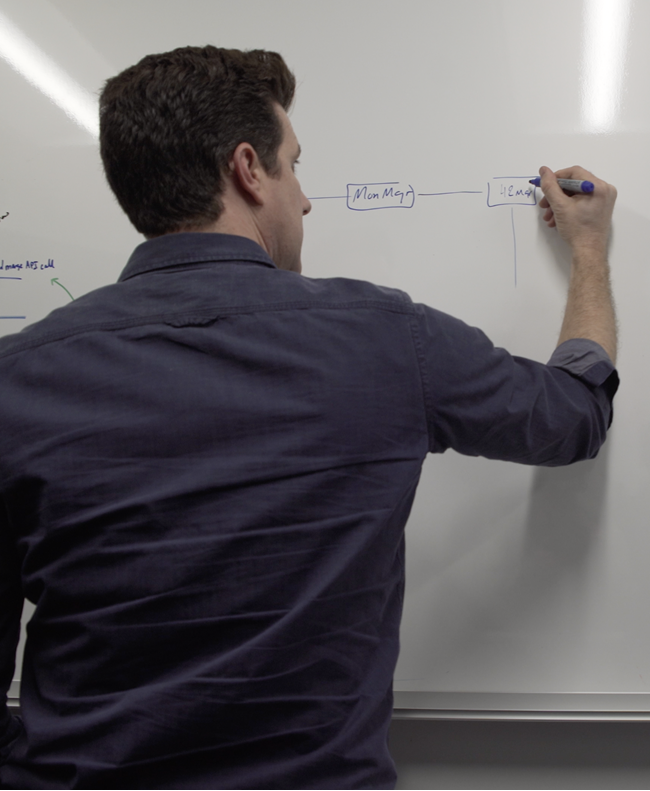
When I joined the LERETA engagement in 2020, the engineering organization had thirty-plus developers across multiple teams working on two flagship products running on mainframe technology. The $20M modernization that followed over the next four years was not primarily about the developers. It was about the architecture: creating the wall-sized diagrams that made the full legacy-modernization critical path visible, establishing the patterns that those teams could execute against consistently, and building the board-level narrative that justified the multi-year investment.
The scale was different. The principle — that architecture is the lever, not headcount — is the same one that governs engineering organizations where AI is doing most of the implementation work.
journey
title The Fractional CTO's Shifting Focus as AI Takes Over Code Authoring
section Orientation
  Map architecture and team: 2: CTO
  Identify governance gaps: 3: CTO
section Transition
  Define AI boundary conditions: 4: CTO
  Install validation layer: 4: CTO
section AI-primary steady state
  Architecture ownership: 5: CTO
  Output governance and audit: 5: CTO
What AI-Primary Development Actually Changes
VentureBeat reported that Anthropic’s own engineering organization now has AI authoring 80% of its production code. That statistic is a leading indicator for the broader enterprise software industry. The question for technology leaders is not whether this ratio will rise — it will — but how an engineering organization, and the CTO role within it, needs to be structured when it does.
The conventional CTO work that involves managing individual contributors writing code is being automated. What cannot be automated is the work of defining the architectural context within which AI-generated code has to operate, the governance framework that keeps that code aligned with business requirements, and the validation layer that catches what AI cannot catch about its own outputs.
This is not a diminished role. It is a different emphasis.
The Architecture Function Becomes the Whole Job
In a human-primary engineering organization, architecture is one of the CTO’s responsibilities. In an AI-primary organization, it becomes the dominant one. The reason is straightforward: AI coding tools produce whatever the context allows them to produce. If the architectural context is well-defined — clear data model, consistent patterns, documented constraints, explicit boundary conditions — AI-generated code tends to stay within the intended design. If the architectural context is vague or inconsistent, the code reflects that vagueness and compounds it at scale.
The LERETA modernization illustrated this principle at an earlier layer. The architecture work — the wall-sized diagrams, the migration critical path, the patterns for 30 developers — created the conditions where those developers could execute consistently without the CTO adjudicating every design decision. The architecture did the management work that would otherwise have required continuous oversight.
AI-primary development amplifies this effect. A well-defined architecture can guide thousands of AI-generated commits toward coherent outcomes. A poorly defined one will produce thousands of inconsistencies, each individually defensible but collectively incoherent.
The Governance Layer That Stays Human
AI-generated code is reliable on patterns it has seen before. It is unreliable on constraints that are implicit — business rules embedded in institutional knowledge rather than documentation, compliance requirements that exist in regulatory language rather than code, architectural constraints established in decisions made years ago and documented nowhere.
This is where the fractional CTO’s human judgment remains irreplaceable. The governance layer — the framework that defines what constraints AI-generated code must satisfy, who validates outputs against those constraints, and how exceptions are escalated and resolved — cannot itself be AI-generated without introducing the exact problem it is meant to solve.
Practically, this means the fractional CTO in an AI-primary engineering organization spends more time on three things than in a traditional engagement: documenting the constraints that AI needs to know about but wasn’t told, building the validation processes that check AI outputs against those constraints, and creating the audit trail that makes AI-generated decisions reviewable.
What This Means for Engineering Team Structure
The effective fractional CTO in this environment is not managing a coding team. They are architecting a system — one where AI agents, human architects, validation processes, and governance frameworks combine to produce reliable, auditable, maintainable software. The skills that make a fractional CTO valuable in this system are the same ones that have always mattered: the ability to see the architecture clearly, make decisions that hold up under future conditions, and build the organizational infrastructure that sustains the work after they leave.
The shift in emphasis is real: less time on sprint planning and code review, more time on the architecture specification that shapes what AI produces and the validation layer that checks it. Organizations that understand this distinction will structure the fractional CTO engagement accordingly — defining the mandate around architecture and governance rather than around development velocity or headcount.
The code is increasingly written by AI. The conditions under which good code gets written are still being defined by humans.