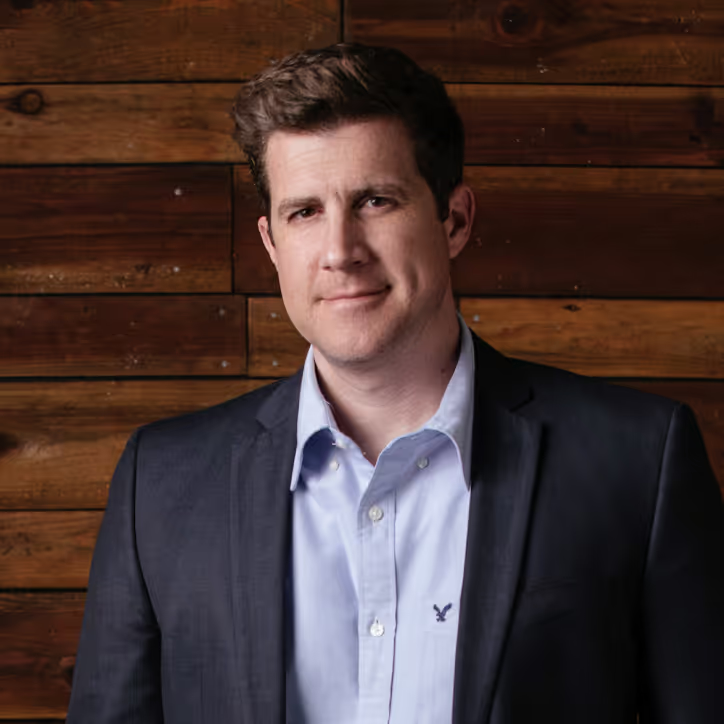
In 2020, I began an engagement at LERETA — the second-largest property-tax processor in the United States, processing roughly $18 billion annually — that ran for nearly five years. The work was not advisory in the traditional consulting sense. It was embedded: leading 30-plus developers across multiple teams, driving a $20 million legacy modernization, creating board-level architecture diagrams that shaped a multi-year investment thesis. The engagement worked because the fractional model was the right structure — deep involvement without the overhead of a full-time executive hire at a moment when the company needed technology leadership and architectural judgment more than headcount.
The fractional CTO role in 2026 looks different from what it looked like in 2020. Not because the fundamental problems have changed. Because AI has changed the speed at which those problems develop and the stakes attached to the decisions that address them.
sequenceDiagram
participant CEO as CEO
participant V as Vendors and Tools
participant FC as Fractional CTO
participant B as Board
Note over CEO,V: Without technology leadership
CEO-->>V: Evaluate AI vendors
V-->>CEO: Pitches and demos
CEO-->>B: We are adopting AI — no technical eval behind it
Note over CEO,FC: With fractional CTO
CEO->>FC: What do we actually need here?
FC->>V: Architecture review — real capability test
FC->>CEO: Honest assessment and recommendation
CEO->>B: Specific plan with measurable ROI target
What the Role Is Not
The fractional CTO is not an AI vendor selector. The market for AI tools has expanded to the point where a list of recommended tools is available from any number of sources — vendors themselves, research firms, industry publications, and peer networks. Producing that list is not what the engagement provides.
The fractional CTO is also not an AI evangelist. The argument that every company must adopt AI immediately is a vendor argument. Some AI applications make clear economic sense for a given organization right now. Others do not. Distinguishing between them requires judgment, not enthusiasm — and the distinction depends heavily on the organization’s data quality, workflow maturity, team capability, and risk tolerance. None of those variables appear in a vendor’s sales deck.
What the engagement provides is the executive judgment that should sit upstream of every significant technology decision: which tools are worth the cost, whether the vendor’s capability claims hold up under architecture review, how to govern what the tools produce, and how to present the technology strategy to boards and investors in terms they can actually evaluate.
What Changed in 2026
Three things about the fractional CTO role have shifted materially in the AI era.
AI governance is now a standard deliverable. Every company with a technology function has AI tools being used somewhere in that function. The question is not whether to include AI governance in the engagement scope — it is how extensive that governance needs to be. At minimum, it means auditing what AI tools are in use, what review process exists for AI-generated outputs, and where AI is being used in ways that create liability exposure. In companies with active AI development programs, governance extends to code review structure, vendor contract review, and model risk assessment.
Vendor evaluation has become more technically demanding. The AI vendor landscape changes faster than any other technology category. Tools adequate in 2024 may be materially behind current options in 2026. Contracts signed at one capability level may be priced incorrectly given the current feature set. And the gap between marketing claims and technical reality is wider in AI than in most technology categories — a platform described as “AI-powered” can represent anything from a thin wrapper over a general-purpose API to a purpose-built system with proprietary training data and measurable performance benchmarks. A fractional CTO evaluates that difference before the contract is signed, not after.
The board-level AI narrative has become a required deliverable. Boards and investors are now asking specific questions about AI strategy, AI governance, AI spend, and competitive AI positioning. Most mid-market leadership teams can answer at the level of “we are using AI tools” — which is not an answer that sophisticated audiences find useful. The fractional CTO’s scope now includes building the board narrative: what is the AI strategy, what is the ROI measurement framework, what are the risks and how are they managed, and where does the company stand relative to industry AI adoption.
What Did Not Change
The fundamentals remain the same. The fractional CTO is the executive accountable for the technology function’s contribution to business outcomes. That accountability covers the engineering team’s capability, the architecture of the systems the business depends on, the vendor relationships supporting those systems, and board-level communication about where technology stands and where it is going.
AI has not replaced any of those responsibilities. It has added to them and accelerated the pace at which they require decisions. Team capability assessment now includes AI tool proficiency and code review discipline. Architecture assessment now includes AI integration patterns and governance frameworks. Vendor review now includes AI capability verification. Board narrative now includes the AI strategy.
The LERETA engagement — five years, 30-plus developers, a $20 million modernization — succeeded not because of a single tool or technology but because there was a consistent architectural point of view driving every decision. That is what experienced technology leadership provides. AI has made it faster to implement a point of view and faster to pay for not having one.
The Right Scope for a Fractional Engagement
The fractional model is appropriate when the need is real but not yet scaled to justify a full-time hire. That describes most mid-market companies in 2026. The typical engagement runs 10 to 15 hours per week, focused on the decisions that have the highest leverage: technology strategy, architecture direction, vendor evaluation, team capability development, and board-level communication.
At that scope, a fractional CTO costs a fraction of a full-time hire’s total compensation while providing the same executive judgment on the decisions that move the company forward. The AI era has not made that judgment less necessary. It has made the consequences of skipping it arrive faster.