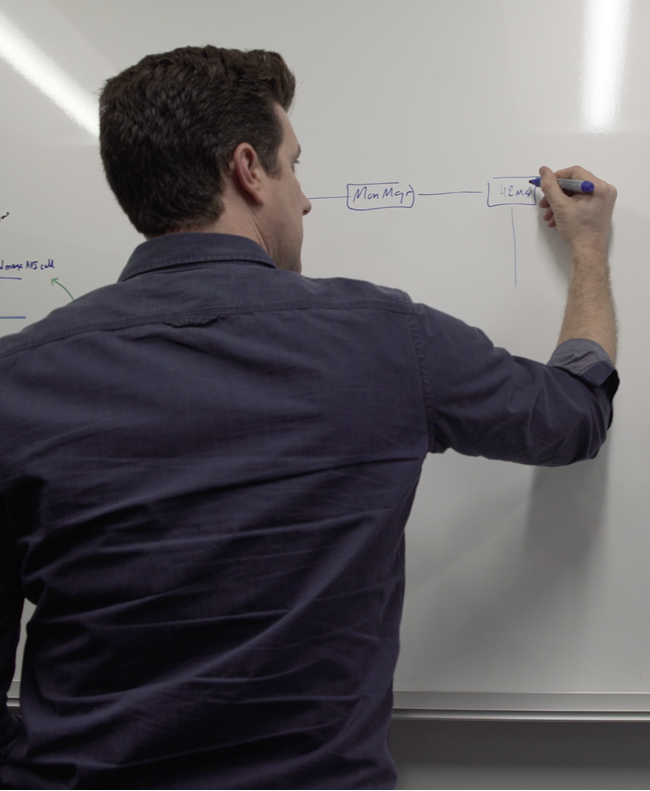
At Carvana in 2016, a five-developer team was parsing millions of vehicle records every day using an event-driven architecture. The velocity that team produced was not from individual brilliance — though they were strong developers — but from architectural clarity. Every developer knew the pattern before writing the first line. The event-driven model was clear, its boundaries were defined, and every new feature extended a known structure rather than inventing a new one. The architecture did the coordination work.
That clarity is exactly what enterprise vibe coding disrupts.
quadrantChart
title Enterprise Vibe Coding Risk Map
x-axis Low Review Discipline --> High Review Discipline
y-axis Low Architecture Alignment --> High Architecture Alignment
quadrant-1 Safe to Ship
quadrant-2 Architecture Review Needed
quadrant-3 Rebuild Zone
quadrant-4 Hidden Risk Zone
Human code with governance: [0.78, 0.82]
Vibe coding with footprint and review: [0.72, 0.70]
Vibe coding with review only: [0.68, 0.32]
Vibe coding unmanaged: [0.18, 0.15]
What the Architecture Gap Actually Is
The architecture gap is not a quality problem. It is a fit problem. AI-generated code can be syntactically correct, well-structured, and test-covered while simultaneously not fitting the system’s design — because quality review and architecture review are answering different questions.
Quality review asks: does this code work? Is it readable? Does it have tests? Does it follow language conventions and linting rules? Those questions are answerable at the file level.
Architecture review asks: does this code fit the system’s design? Does it communicate through the right channels? Does it respect the established module boundaries? Does it use the authorization framework as designed or route around it? Does it create dependencies that weren’t part of the design? Those questions require understanding the system’s full design — context that code review alone does not provide.
AI coding tools are optimized to produce code that passes quality review. They are not designed to know your system’s architectural decisions unless those decisions are embedded in the context they’re given. The result is a gap that forms in plain sight: code that looks correct to everyone except the person who holds the architecture in their head.
Why Enterprise Scale Makes This Worse
The Carvana team numbered five people. Five developers in one room can maintain architectural consistency through direct communication. The architecture is shared knowledge because the team is small enough to share it.
An enterprise engineering organization running vibe coding across 20 teams, 150 developers, and three product lines cannot maintain that shared knowledge through communication alone. Each team’s AI sessions operate independently. Each developer’s prompt context reflects their local understanding of the system, not the global architectural design. The drift doesn’t happen in one place — it accumulates across every team, every session, every sprint.
The integration cost compounds at the same rate. A module that bypasses the established service layer in one team’s codebase is an isolated problem. The same pattern replicated across eight teams creates an architectural parallel track — a shadow architecture that is now maintained alongside the designed one, consuming resources that were allocated to new features.
The Quadrant That Keeps Architects Awake
The risk map has four regions. Code in the rebuild zone — low quality, low architectural alignment — is bad and visible. Code in the top-left — well-reviewed but architecturally misaligned — is bad and invisible until the integration point.
Vibe coding without architecture review lands in that quadrant. The code looks fine. It passes. It ships. The misalignment accumulates over six months of shipping, and the discovery happens during a migration project, an audit, or a production incident — by which point the correction cost is an order of magnitude higher than it would have been at the point of generation.
The hidden risk quadrant is what makes enterprise vibe coding governance non-optional at scale. The standard quality review process is not designed to catch it, and the standard development workflow does not create a natural checkpoint to find it.
The Three-Zone Model
The most workable enterprise vibe coding policy distinguishes three zones.
Green Zone covers prototyping, internal tooling, and experiments that don’t reach production systems. AI-generated code is unencumbered — speed is the goal, and architectural fit is a secondary concern. This is where vibe coding at full velocity belongs.
Yellow Zone covers production-bound features in areas where the architecture is well-established and the blast radius of misalignment is bounded. AI assistance is permitted, and the code goes through the standard code review process plus an architecture checkpoint before merge. The checkpoint doesn’t have to be an architect — it can be a senior developer with context, or an automated check against a defined architectural specification. What it cannot be is nothing.
Red Zone covers regulated systems, authentication and authorization components, security-sensitive infrastructure, and areas with high integration complexity. AI assistance is permitted for research and drafting. Every line in the final commit is architect-reviewed before it goes to code review. This is not a performance bottleneck — it is a surface area control. The most consequential parts of the system are the ones where the gap between AI-generated code and the design intent is most expensive.
The boundary between zones has to be published and explicit. Ambiguity at the boundary doesn’t create thoughtful decision-making — it defaults to the fastest path, which is usually Green Zone treatment for Yellow Zone code.
What Governance Infrastructure Looks Like in Practice
Publishing a policy document is the beginning, not the end. The governance infrastructure that makes the policy real includes three things.
An architectural specification that is readable in AI context. If the AI coding tools don’t have access to the architectural decisions — the module design, the communication patterns, the authorization model — they can’t follow them. The spec has to be in a form the AI can read, which means embedded in the codebase, not in a Confluence page.
An architecture review checkpoint that’s integrated into the development workflow. Not a separate process that developers opt into — a required gate for Yellow and Red Zone code that is built into the pull request process. The gate can be lightweight: a checklist, a review from a designated reviewer, an automated pattern check. What it cannot be is optional.
Metrics that surface drift before the integration point. Code ownership metrics, module dependency graphs, and pattern-consistency checks can identify architectural misalignment earlier than the integration review. These are automated tools, not manual audits. The goal is to surface the hidden risk quadrant before it becomes production debt.
The teams that will be ahead of this in 12 months are the ones establishing the zone boundaries now — before the volume of AI-generated production code makes the correction work a quarter-long project.